AI SDRs (Sales Development Representatives) automate early-stage sales tasks like prospecting, personalized outreach, lead qualification, follow-ups, and scheduling. They save time, boost efficiency, and scale outreach by leveraging real-time lead data - constantly updated insights about prospects, such as job changes, company updates, and behavioral signals. This dynamic approach enhances lead scoring accuracy by up to 40% and improves response rates by 40-60%, enabling tailored, timely communication.
AI SDRs, like Salesforge's Agent Frank, integrate with tools like LinkedIn and CRMs to automate the entire sales process, from lead generation to meeting booking. With pricing starting at $499/month, they offer scalable solutions for businesses aiming to streamline sales efforts and maximize results.
An AI SDR (Sales Development Representative) is like a digital assistant for sales teams, designed to handle the early stages of the sales process. By leveraging real-time, enriched data, these AI tools refine prospect profiles, identify leads, send tailored messages, and even manage follow-ups across platforms like email and LinkedIn. The main objective? To take repetitive tasks off human SDRs’ plates, so they can focus on closing deals.
Here’s how it works: AI SDRs start by automating prospecting. They pull data from over 50 sources to find leads that fit your Ideal Customer Profile (ICP). They analyze behaviors like website visits, job changes, or funding announcements to pinpoint the best opportunities. Next, they enrich these profiles by filling in missing details, such as contact information or technology usage. Using natural language processing (NLP), the AI then crafts personalized outreach, referencing specifics like the prospect’s role, recent company updates, or industry challenges. Finally, follow-ups are fully automated, from responding to replies to handling objections and scheduling meetings. This entire process runs smoothly without requiring human input, ensuring targeted and efficient outreach.
The impact is tangible: sales teams see about 40% higher accuracy in lead qualification and can scale their outreach efforts by 5–10 times. These benefits set the stage for the advanced features discussed below.
AI SDRs bring a range of features that enhance multi-channel outreach. They coordinate personalized communication across email, LinkedIn, text, and even AI-generated videos, ensuring prospects are engaged on their preferred platforms. Using data from tools like HubSpot or LinkedIn profiles, AI SDRs tailor messages to address specific pain points or highlight recent activities, making outreach feel personal and relevant. Plus, they work around the clock, continuously qualifying leads and sending follow-ups, even when your human team is offline.
Unlike human SDRs, who have a natural limit to how many interactions they can handle daily, AI SDRs can manage a massive volume without breaking a sweat. They also learn from every interaction, fine-tuning their messaging to improve response rates. And because they integrate seamlessly with existing tools, your CRM stays updated in real time, and qualified leads are instantly routed to the right account executives.
The stats speak volumes: human SDRs spend only about 35% of their time actively selling, with the rest eaten up by tasks like research, data entry, and routine outreach. Scaling these efforts without constantly hiring more people is a tough challenge. AI SDRs tackle this by automating the heavy lifting - prospecting, initial lead qualification, and follow-up sequences - allowing human reps to focus on what they do best: engaging with prospects who are ready to buy.
(function(d,u,ac){var s=d.createElement('script');s.type='text/javascript';s.src='https://a.omappapi.com/app/js/api.min.js';s.async=true;s.dataset.user=u;s.dataset.campaign=ac;d.getElementsByTagName('head')[0].appendChild(s);})(document,372145,'tu1or50rqqejh816h1cm');
What sets modern AI SDRs apart from outdated, one-size-fits-all methods? Real-time lead data. Unlike static lists that quickly lose relevance, AI SDRs rely on constantly updated streams of information that reflect a prospect's most recent activity. This dynamic approach ensures outreach efforts stay timely, relevant, and aligned with a prospect's current business needs.
By combining firmographics (like company size, revenue, and industry), technographics (such as current tech stack and software usage), and buyer intent signals (like website visits to pricing pages, content downloads, or funding announcements), AI SDRs gain a complete picture of who to contact, when to reach out, and what message to deliver. For instance, imagine this: a prospect has just raised Series B funding, uses Salesforce, and recently visited your integrations page. With this data, an AI SDR can craft a highly specific message about scaling their sales operations, tailored to their exact situation.
This level of enriched personalization isn’t just a nice-to-have - it delivers results. Cold outreach response rates improve by 40-60% when personalization is data-driven. And here’s the kicker: companies that respond to leads within five minutes are 100 times more likely to connect and 21 times more likely to qualify those leads. That kind of speed is only achievable when AI SDRs work with data that updates continuously, not on a fixed schedule. It’s this constant flow of fresh data that enables smarter, more effective outreach, which we’ll dive into next.
Traditional lead scoring often relies on static criteria that don’t change frequently. AI-driven real-time scoring flips the script by focusing on behavioral signals and intent strength, with recent actions carrying the most weight. For example, if a prospect downloads a case study, visits your pricing page multiple times in one day, or posts a job opening for a role your product supports, their score is instantly updated, and they’re moved up the priority list.
This dynamic scoring system helps sales teams focus their efforts on prospects who are actively signaling buying intent, rather than wasting time on cold leads. It’s no wonder that 84% of sales leaders believe AI will play a much larger role in lead generation within the next two years. A prime example of this is how companies track past champions - those who’ve switched jobs but remain advocates for your product.
Take Sendoso, a gifting platform, as an example. In October 2025, they used the Gem-E AI agent from UserGems to automate the tracking of job changes and website visits. By integrating this real-time data with Salesforce, their small seven-person team achieved a 20% reply rate and created 47 new opportunities in just 30 days.
The takeaway? Set up your AI SDR to act immediately when leads visit high-intent pages like pricing or demo request pages. These "hand-raisers" are far more likely to convert when contacted within minutes rather than hours or days.
Building on the foundation of real-time scoring, AI SDRs also maintain live lead profiles that evolve with every new piece of data. People get promoted, companies acquire competitors, and tech stacks change - all of which can instantly make your previous outreach irrelevant. AI SDRs solve this problem by using identity resolution, which continuously matches data from multiple sources to track updates like job changes, funding rounds, mergers, or new technology adoptions in real time.
This ensures that every interaction is informed by the most up-to-date information. For example, if a lead you contacted months ago has been promoted to VP of Sales at a new company, the AI SDR updates their profile immediately. This allows for context-driven outreach that acknowledges these changes. Instead of relying on manual updates, the system adapts automatically, ensuring your messaging stays relevant and timely.
This shift to real-time data processing is transforming how sales teams operate. By moving beyond static data, they can engage prospects with insights that are always current, creating opportunities for more meaningful and productive conversations.
Previously, we looked at how dynamic profiles help create targeted outreach. Now, let's dive into the clear advantages of using AI SDRs powered by real-time data. These tools save time, make outreach more personal, and boost conversion rates. Here's how these benefits play out in real-world scenarios.
AI SDRs handle time-consuming tasks like prospect research on LinkedIn, updating CRM records, and drafting individual emails. By automating these repetitive processes, sales teams can focus on closing deals instead of administrative work. A great example of this is AKOOL, which used Salesforge's platform to reach 214,000 prospects quickly, achieving a positive reply rate of over 16%.
"Outreach at our scale requires speed, segmentation, and precision - Salesforge gave us the infrastructure to do it all at once." - AKOOL Team
With real-time data, AI SDRs can craft messages tailored to current events, such as funding announcements, new hires, or tech updates - on a large scale. For instance, ChannelCrawler saw an 85.71% positive reply rate by running highly targeted campaigns using Salesforge's spintax and inbox management tools. The system tracked behavioral signals, like visits to pricing pages or content downloads, to trigger immediate follow-ups. This level of personalization, impossible to achieve manually, leads to significantly higher engagement across email and LinkedIn.
The combination of personalization and real-time insights leads to better conversions. AI SDRs continuously refine their outreach based on live behavioral data, targeting prospects with clear buying intent. VAI Consulting used Salesforge's AI SDR, Agent Frank, to automate prospecting and messaging, booking three qualified sales calls in just one week. By instantly prioritizing prospects who interact with key content - like downloading whitepapers or revisiting demo pages - the system creates a pipeline of leads more likely to convert.
Agent Frank, Salesforge's AI-powered Sales Development Representative (SDR), is designed to handle the entire outbound sales process. From identifying leads within a database of over 500 million contacts to crafting personalized, multi-channel messages, managing follow-ups, and even booking meetings, this tool does it all. What makes it even more effective is its ability to refine lead profiles in real-time. By tapping into data like LinkedIn activity, company news, or job changes, it ensures that outreach remains relevant and timely.
The platform manages an impressive workload, processing between 2,000 and 2,500 new leads and sending 6,000 to 7,500 personalized emails each month. It seamlessly integrates with Salesforge's suite of tools, including Leadsforge for sourcing leads, Warmforge for warming up email accounts, and Primebox for managing inboxes. This integration is a key factor behind its ability to handle such high volumes and deliver results across multiple channels.
In early 2025, VAI Consulting started using Agent Frank, and within just one week, it had booked three qualified sales calls. Ryan Van Hout, Partner and Co-Founder, highlighted how the AI agent allowed them to "scale rapidly" while maintaining their brand's quality.
Agent Frank takes outbound sales strategies to the next level by combining real-time enriched profiles with unmatched scalability and integration. Unlike other tools that focus solely on personalization or lead data, Agent Frank provides a fully automated solution. It supports unlimited LinkedIn sender profiles and includes email warm-up capabilities through Warmforge. By leveraging data from multiple sources, it enables hyper-personalized messaging that resonates with prospects.
The system is also highly customizable. Users can upload product brochures, documentation, and website links to train the AI on their specific offerings and brand voice. It even offers nine distinct tonalities, allowing teams to tailor outreach based on specific goals like "Send Meeting Link" or "Receive Meeting Link".
A great example of its impact is UniteSync, led by CEO Carlos Palop. Using Salesforge's tools, the company achieved an 85.26% positive reply rate and brought its customer acquisition cost (CAC) down to just $2.86. This efficiency has enabled them to onboard 4 to 5 new music creators daily by targeting those with unclaimed royalties.
"Our CAC is currently $2.86, and we expect it to decrease even further. We're currently onboarding 4 to 5 new music creators every day."
– Carlos Palop, CEO, UniteSync
Agent Frank offers a pricing model designed to be both scalable and cost-effective, making it an attractive alternative to traditional SDRs. For higher volumes, the platform charges $0.25 per active contact for over 2,000 contacts. Smaller-scale users can opt for plans starting at $499 per month (billed annually) or $599 per month (billed quarterly) for 1,000 active contacts. These plans include full access to the platform, covering automated prospecting, multi-channel outreach, and dedicated support.
Salesforge claims that Agent Frank can cut sales overhead costs by up to 16 times compared to hiring a human SDR. To ensure high deliverability, the platform includes a two-week email warm-up period via Warmforge before launching full campaigns. Additional infrastructure options are also available, such as Infraforge (starting at $33/month for 10 mailboxes) and Megaforge (starting at $69/month for 20 mailboxes).
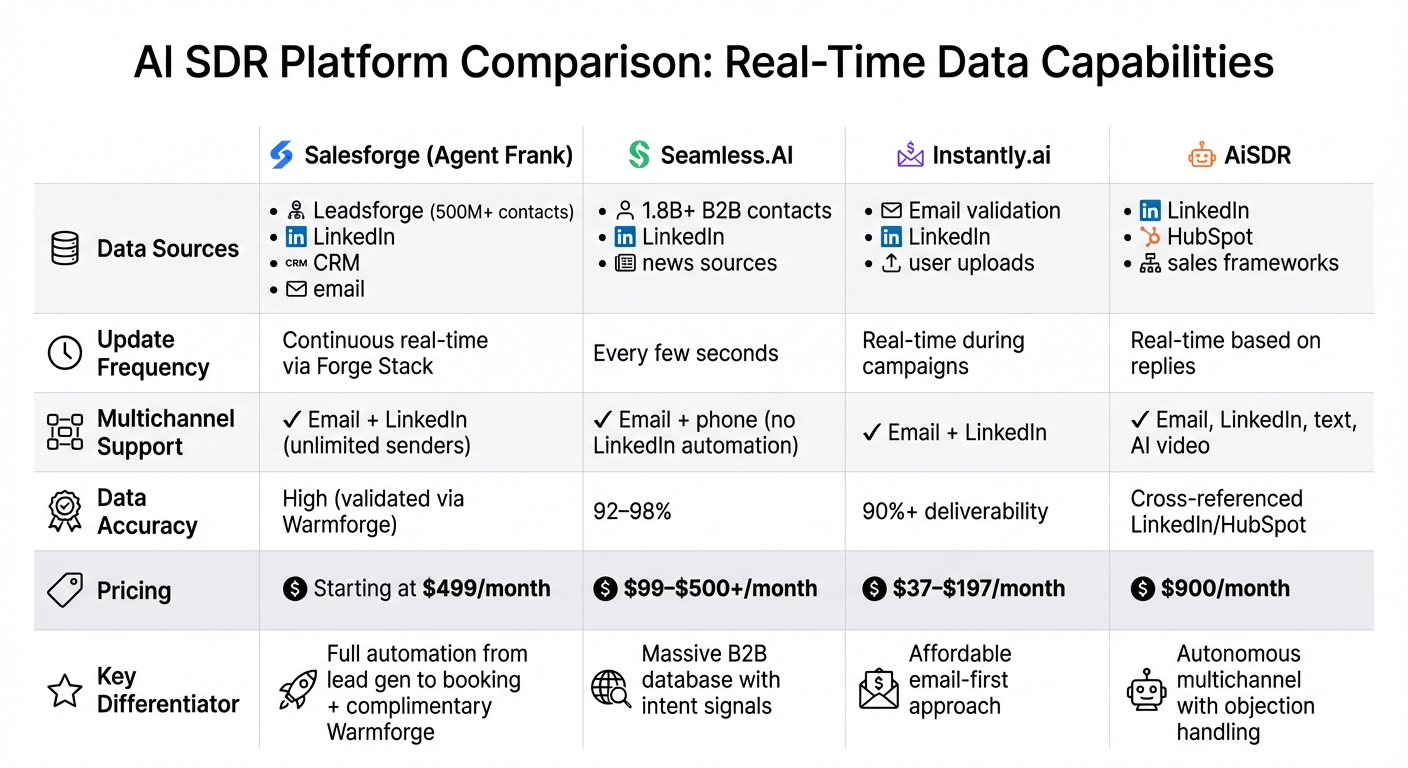
AI SDR Platform Comparison: Features, Pricing, and Capabilities
When selecting an AI SDR platform, it’s essential to consider how well it handles real-time data, scales outreach efforts, and balances cost efficiency. Agent Frank leads the pack with its fully automated approach and seamless integration within The Forge Stack, while other platforms like Seamless.AI, Instantly.ai, and AiSDR each bring their own strengths to the table. Let’s dive into what makes each platform stand out in the evolving landscape of real-time data.
Seamless.AI specializes in real-time B2B contact sourcing, boasting a database of over 1.8 billion contacts with accuracy rates ranging from 92% to 98%. The platform continuously refreshes its data every few seconds and leverages intent signals, firmographics, and technographics to refine its results. However, it lacks built-in LinkedIn automation, requiring users to rely on external tools for multichannel outreach.
Instantly.ai shines in email deliverability and AI-driven personalization at scale. It supports both email and LinkedIn sequences, though the quality of its data depends heavily on user-provided inputs. With deliverability rates exceeding 90% and pricing starting at just $37 per month for basic plans, it’s an attractive choice for smaller teams. Users often report achieving 2- to 5-times higher reply rates thanks to its real-time personalization capabilities.
AiSDR takes multichannel outreach to the next level, automating email, LinkedIn messaging, text, and even AI-generated video content. It integrates live data from LinkedIn and HubSpot, dynamically updating lead profiles based on interactions and replies. Priced at $900 per month for its full feature set, AiSDR positions itself as a premium solution for teams seeking autonomous engagement, complete with built-in objection handling.
Below is a side-by-side comparison of these leading platforms to help you weigh the options.
| Feature | Salesforge (Agent Frank) | Seamless.AI | Instantly.ai | AiSDR |
|---|---|---|---|---|
| Data Sources | Leadsforge (500M+ contacts), LinkedIn, CRM, email | 1.8B+ B2B contacts, LinkedIn, news sources | Email validation, LinkedIn, user uploads | LinkedIn, HubSpot, sales frameworks |
| Update Frequency | Continuous real-time via Forge Stack | Every few seconds | Real-time during campaigns | Real-time based on replies |
| Multichannel Support | Email + LinkedIn (unlimited senders) | Email + phone (no LinkedIn automation) | Email + LinkedIn | Email, LinkedIn, text, AI video |
| Data Accuracy | High (validated via Warmforge) | 92–98% | 90%+ deliverability (depends on inputs) | Cross-referenced LinkedIn/HubSpot |
| Scalability | Fully automated multi-channel outreach | 10,000+ daily searches, API access | Millions of emails per month | Autonomous at volume |
| Pricing | Starting at $499/month* | $99/month (basic) to $500+/month (enterprise) | $37/month (starter) to $197/month (pro) | $900/month (all features) |
| Key Differentiator | Full automation - from lead generation to booking - with complimentary Warmforge access | B2B database combined with robust intent signals | Affordable, email-first approach | Autonomous multichannel outreach with objection handling |
Agent Frank’s pricing becomes increasingly attractive for high-volume users, especially when factoring in its complimentary Warmforge access and unlimited LinkedIn senders. Seamless.AI and AiSDR cater to teams that need expansive databases or fully autonomous operations, while Instantly.ai provides a cost-effective entry point for teams focused on email campaigns.
AI SDRs, fueled by real-time lead data, are changing the game for outbound sales teams. By automating tasks like prospecting, tailoring outreach with dynamic profiles, and prioritizing top-quality leads instantly, these tools lighten the workload for human reps. The results speak for themselves: a 40% reduction in qualification time and a 25% boost in conversion rates. This means teams can turn a high volume of leads into a strong pipeline - without the need to grow their headcount.
Rather than replacing human reps, AI SDRs complement their efforts. They handle time-consuming tasks like research, initial outreach, and scheduling, leaving human salespeople free to focus on what they do best: building relationships and closing deals. With the help of real-time data, every message becomes timely and relevant - whether it’s responding to fresh LinkedIn activity or engaging with email interactions within minutes.
This evolution sets the stage for tools like Agent Frank, which blend automation with personalization seamlessly. Salesforge’s Agent Frank is a prime example, automating the entire process from lead generation to meeting booking. Integrated into The Forge Stack, it offers features like unlimited LinkedIn senders and deliverability powered by Warmforge, enabling teams to scale multi-channel outreach from a single platform. Take UniteSync, for instance - they achieved an 85.26% positive reply rate and a $2.86 CAC in 2024 using this comprehensive setup.
For sales teams looking to scale their personalized outreach, Salesforge provides the automation, deliverability, and real-time insights needed to stay ahead. The future of outbound sales isn’t just about speed - it’s about being smarter, more efficient, and leveraging data that works around the clock.
AI SDRs take lead scoring to a whole new level by making it dynamic and behavior-driven. Instead of sticking to static factors like job title or company size, these systems analyze real-time engagement signals - things like email opens, link clicks, website activity, and LinkedIn interactions. Using this data, machine learning models constantly update lead scores, ensuring that the most engaged prospects are always at the top of the outreach list.
Take Agent Frank (Salesforge’s AI SDR), for example. It can distribute leads across multiple channels, such as email and LinkedIn, based on their activity. Let’s say a prospect is active on LinkedIn but hasn’t responded to emails - Agent Frank can prioritize that lead for a LinkedIn follow-up. This kind of real-time flexibility allows AI SDRs to accurately gauge buying intent and direct resources, like tailored messages or calls, toward the most promising leads. Meanwhile, less engaged prospects receive automated follow-ups, keeping the process efficient.
By continuously updating lead scores and fine-tuning outreach strategies across various channels, AI SDRs enable sales teams to zero in on leads that are ready to convert. The result? Better reply rates, faster-moving sales pipelines, and predictable costs - all without the heavy lifting.
AI SDRs present a budget-friendly alternative to traditional human SDRs by swapping out hefty salaries and commissions for a fixed monthly subscription. Take the Salesforge Agent Frank license, for instance - it costs $499 per month and comes packed with perks like unlimited mailboxes, multilingual email generation, and a built-in warm-up feature. Compare that to a human SDR, who typically earns a base salary between $50,000 and $70,000 annually, plus commissions and benefits, often pushing total costs beyond $100,000 per year.
What’s more, AI SDRs operate around the clock, managing thousands of leads through tasks like prospecting, personalized outreach, follow-ups, and scheduling meetings - all at a pace no human SDR could match. They also cut out additional costs like recruitment, training, and office space. On top of that, these AI tools provide real-time lead enrichment and scoring without needing extra team members. When stacked against competitors like Closely or Salesforce, Salesforge stands out with its simpler, more affordable setup and scalable features that adapt to your needs.
Real-time lead data turns static prospect lists into living, breathing profiles that AI-powered SDRs can act on instantly. Imagine this: a prospect gets a promotion, a company secures fresh funding, or someone visits your website - this data is automatically updated in real time. No more digging through outdated spreadsheets or wasting time on manual research. Instead, outreach becomes laser-focused, timely, and relevant.
Take Agent Frank, Salesforge’s AI SDR, for example. This tool uses up-to-the-minute data to craft personalized messages that reference recent updates, prioritize leads showing activity, and trigger follow-ups the moment a prospect signals interest. Engagement signals like email opens, link clicks, or website visits are constantly fed into the system, recalibrating lead scores on the fly and ensuring your efforts are directed where they matter most.
What’s the payoff? Teams using real-time data have reported reply rates skyrocketing by up to 140% and conversion rates improving by 30–50%. By keeping outreach tailored and perfectly timed, real-time lead data doesn’t just improve efficiency - it drives tangible growth and sales success.
.jpg)



.jpg)